vs PM Tools
OpX OS vs generic PM tools — they track tasks, OS runs improvement.
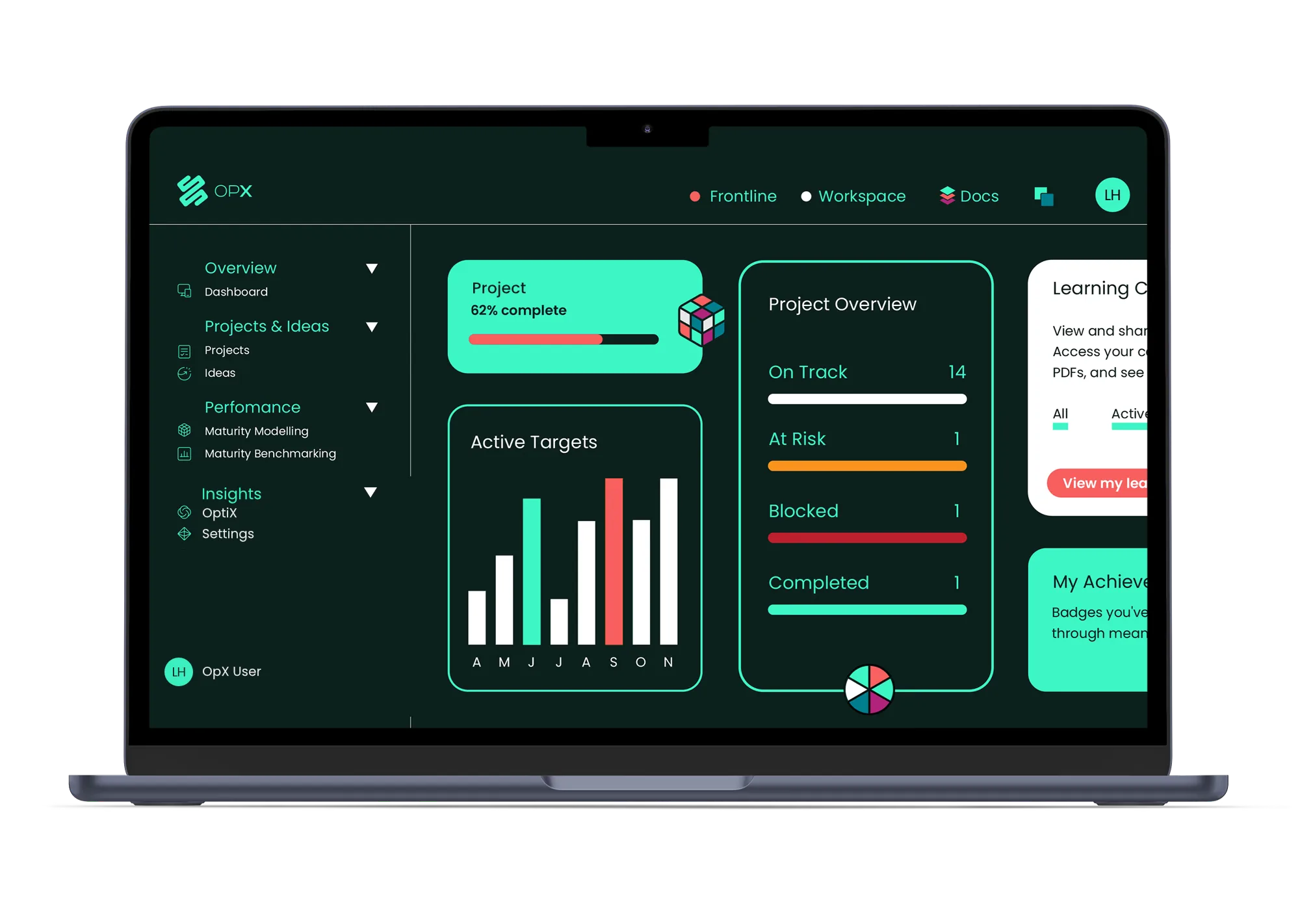
Asana, Jira and Monday are excellent work-management platforms. They track tasks, projects and tickets. They are not improvement systems. OpX OS is the operating system for improvement work — methodology workbench, audit trail, maturity assessment, capability tracking and idea pipeline, on one platform that connects to whatever PM tool you already run.
Why PM tools aren't improvement systems
Tracking tasks is not the same as running improvement.
PM tools were built to coordinate work and surface delivery status. Improvement work needs more than a board view — it needs a methodology workbench that holds A3, DMAIC, Kaizen, 8D and PDCA consistently; an audit trail that survives an ISO review; a maturity framework that benchmarks site against site against sector; capability tracking that updates by activity, not by annual survey; and a learning layer that sits inside the improvement work, not next to it. PM tools can do the project view well. They were never designed for any of the rest.
Side-by-side: PM tools vs OpX OS.
| Capability | Asana | Jira | Monday | OpX OS |
|---|---|---|---|---|
| General task / project tracking | ✓ | ✓ | ✓ | ✓ |
| Methodology workbench (A3 · DMAIC · Kaizen · 8D · PDCA) | ✗ | Partial | ✗ | ✓Native |
| Stage-gate closure validation | ✗ | ✗ | ✗ | ✓ |
| Audit-ready decision log | ✗ | Partial | ✗ | ✓ |
| Maturity assessment framework | ✗ | ✗ | ✗ | ✓15-dimension, Cardiff-validated |
| Capability tracking by activity | ✗ | ✗ | ✗ | ✓ |
| LCS-accredited learning layer | ✗ | ✗ | ✗ | ✓ |
| Frontline idea pipeline → scale | ✗ | ✗ | Partial | ✓ |
PM tools fill the project-tracking column well. OpX OS sits alongside them, not on top of them — connect via Connect, the improvement work runs on OS.
OpX OS vs Asana
Asana is excellent for cross-functional coordination — less so for improvement.
Asana shines on cross-functional coordination, marketing calendars and product launches. It does not have a methodology workbench, a maturity framework, an audit-ready decision log, or a capability layer that updates by activity. Teams that try to run an improvement programme inside Asana end up with project boards that look like everything else — no clear methodology, no closure validation, no roll-up to leadership that survives the next audit cycle. OpX OS sits alongside Asana via Connect: keep your team's existing Asana workflow; run improvement on OS.
OpX OS vs Jira
Jira is built for engineering tickets — not for improvement methodology.
Jira excels at engineering team workflows — backlog, sprint, ticket, release. Improvement methodology lives in a different shape: A3, DMAIC, Kaizen, 8D, PDCA. These don't map cleanly to Jira's epic/story/task hierarchy. Plugins help on the margins but introduce their own audit-trail gaps. OpX OS gives improvement work its own methodology workbench — closure validated by the system, decisions time-stamped, every stakeholder logged — and connects to Jira via Connect for engineering work that's already there.
OpX OS vs Monday
Monday is a flexible work-management board — not a structured improvement system.
Monday's strength is the board view — flexible, configurable, fast to adopt. That flexibility cuts both ways. Improvement work needs structure: the same methodology run the same way every time, with stakeholders logged, decisions time-stamped, closure validated. Monday can be customised toward this, but customisation isn't a system of record. OpX OS gives improvement work the structure it needs, and connects to Monday for whatever your PMO and ops team already manage there.
When it matters
When the regulator, the board, or the next CFO asks: which system tells the truth?
Improvement programmes attract scrutiny — from finance, from ISO auditors, from the board, from the regulator in regulated sectors. The question isn't "do we have a PM tool?" — it's "what system is the source of truth for the improvement work, the audit trail, the capability data and the maturity score?" PM tools don't answer that question. OpX OS does.
Three products. One capability footprint.
The integration layer
Connect
Open API, native connectors, signed webhooks. OS plugs into what you already run.
See ConnectServices & human delivery
Campus
Onboarding, cohorts, partner content, enablement. The human layer around OS.
See CampusThe accredited curriculum
Academy
LCS-accredited learning with Cardiff University. Now native to OS as Foundations.
See Academy